

Built to the standards your auditors read.
Governments and standards bodies are setting out what businesses must do to use AI responsibly. Fortrius AI’s safeguards are built to three of the most widely used, following the strictest requirement where they overlap, so your compliance team has the controls and the records it needs.
EU AI Act
The European Union’s AI law. Applies to organizations using AI in connection with the EU.
ISO/IEC 42001:2023
The international standard for managing AI responsibly. Often requested in supplier reviews.
NIST AI RMF 1.0
The US government’s framework for managing AI risk. Voluntary, and widely used as a common language.
Human oversight, named in law.
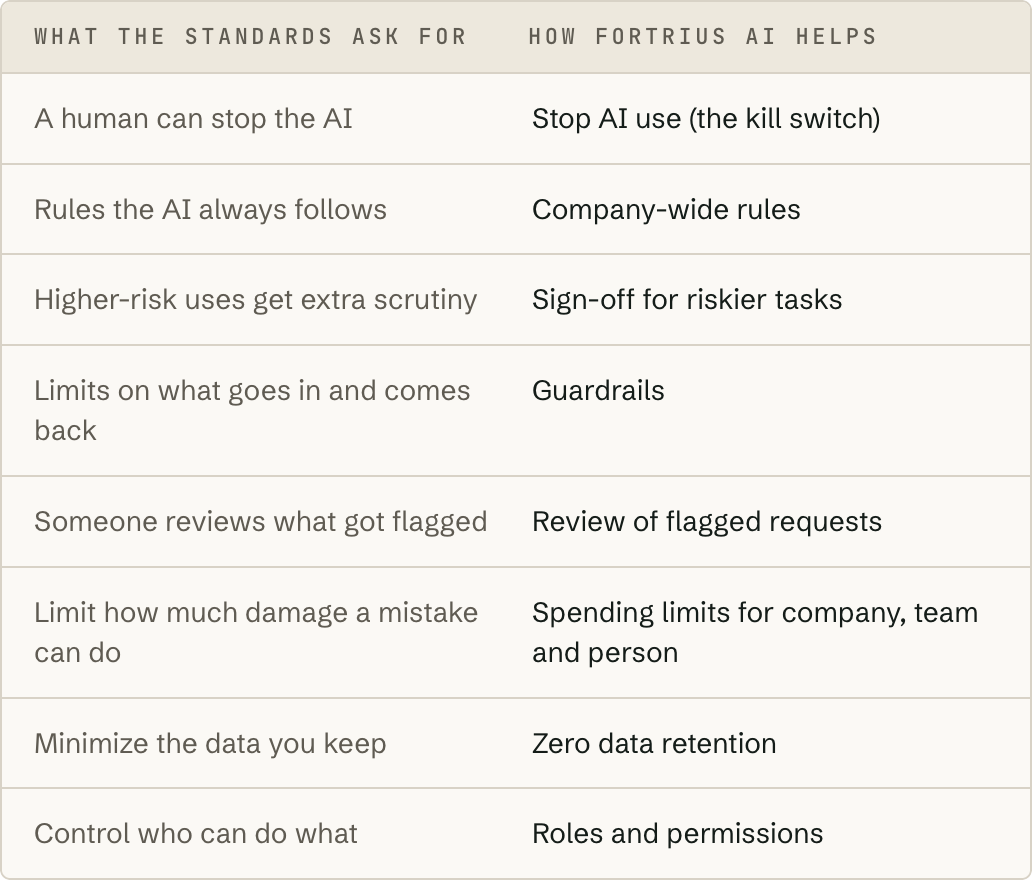
For high-risk AI systems, the Act says the people overseeing the system must be able to do five things. Here’s how Fortrius AI supports each.
Separately, Article 26(6) requires businesses using a high-risk AI system to keep its logs for at least six months. Fortrius AI keeps the audit log for a full year, twice that.
Proof your AI policies are actually followed.
Policies enacted, not just written.
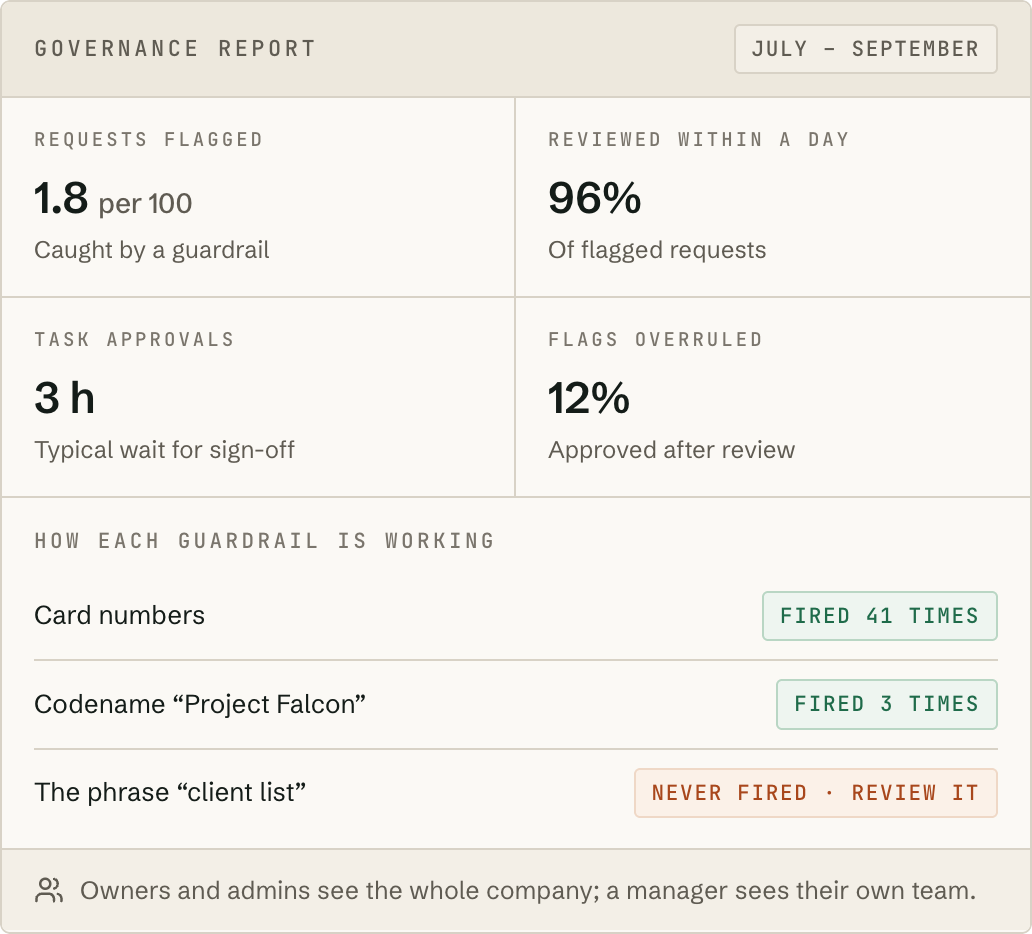
How governance fails while looking healthy, and what stops it.
Approving without looking
Only riskier tasks need sign-off, and rushed reviewing is surfaced.
Unofficial AI use
An approved way to use AI that’s easier than working around it.
Nobody accountable
Every approval and review decision is recorded against a named person.
Safeguards added too late
The controls work from the first request, not as an add-on later.
Need an AI policy? We’ll help you write one.
Answer a few questions about how your team uses AI, and Fortrius AI drafts a plain-English AI policy for your business, ready to edit and share with your team.
Fortrius AI is built to these standards; it is not certified against them. This describes how a software product is built. It is not legal advice.
Send us the questionnaire.
Vetting Fortrius AI as a supplier? Send your security questionnaire to security@fortrius.ai and we’ll show how each requirement is met.
Email security@fortrius.ai →